There is a practice so normalised in Indian workplaces that most employees do not even consider it a form of wrongdoing. A field sales rep is stuck in Mumbai traffic on the Western Express Highway. He calls a colleague already at the office and says, “Yaar, please mark my attendance.” The colleague obliges without a second thought. No big deal, right?
Wrong. This is proxy attendance, or what is globally called “buddy punching,” and it is quietly bleeding businesses across India every single month.
What Exactly Is Proxy Attendance?
Proxy attendance happens when one employee marks another person’s attendance without them actually being present at the designated location or within working hours. It sounds like a small favour, but at scale, it turns into a systematic leak in your payroll and your workforce data.
It happens in two main ways. The first is the morning scenario: someone is running late, so a colleague marks them present at the scheduled start time. The second is the end-of-day scenario: someone needs to leave early but asks a coworker to punch them out later. In both cases, your company is paying for hours that were never actually worked.
In field-heavy industries like pharma distribution, FMCG sales, construction, or logistics, this problem gets compounded. When attendance is self-reported or relies on manual registers at remote sites, there is very little stopping employees from calling in their attendance from home or a chai shop two kilometres away from the job site.
Why This Problem Hits Indian Businesses Harder
The Indian work culture, particularly in field operations, runs heavily on relationships and loyalty within teams. Asking a colleague for a favour feels natural, even expected. Nobody wants to be the person who refuses to help a teammate out. This makes proxy attendance culturally sticky in a way that is harder to address than in other markets.
There is also the matter of scale. A mid-size distribution company in India might have 200 to 500 field executives spread across dozens of cities. A manufacturing plant might run three shifts with hundreds of workers. When your workforce is this distributed, manual oversight becomes nearly impossible, and proxy attendance becomes routine rather than occasional.
Add to this the infrastructure realities: inconsistent internet connectivity in tier-2 and tier-3 cities, reliance on WhatsApp for attendance reporting in many companies, and the fact that many businesses are still transitioning away from physical registers. All of this creates an environment where proxy attendance can thrive unchecked.
What It Actually Costs You
Let us be direct about the numbers. Research from the American Payroll Association found that businesses can lose up to 2.2% of their gross annual payroll to time theft, with buddy punching being one of the leading contributors. For a company with 300 field employees earning an average of Rs. 25,000 per month, that translates to a loss in the range of Rs. 16 to 18 lakhs every year. Not a rounding error.
But the financial damage is only part of the picture.
Distorted workforce data: When attendance records do not reflect reality, your planning goes wrong. You are making decisions about staffing, productivity, and field coverage based on data that simply is not true.
Inaccurate client billing: For companies that bill clients based on man-hours deployed at sites, proxy attendance directly affects invoicing accuracy and can create disputes.
Fairness problems within teams: The employees who do follow the rules and do show up on time begin to notice that their punctuality is not rewarded while others game the system freely. Resentment builds quietly.
Legal exposure: Under Indian labour law, if you pay an employee for hours they did not work and later try to withhold pay, you are in murky territory. The complexity of wage and attendance disputes under the Industrial Disputes Act makes it far better to have verifiable records from the start.
Why Employees Do It
This is worth understanding before you jump to enforcement.
In many cases, proxy attendance is a symptom of a deeper problem. If your shift starts at 9 AM in an area where peak traffic clears at 9:30 AM, employees are almost guaranteed to be late regularly. If your attendance policy is vague or inconsistently enforced, people will find workarounds. If there is no easy way to report a genuine delay through official channels, the path of least resistance is calling a colleague.
Sometimes it comes down to fear. If a late mark means a salary cut or a manager’s reprimand, an employee will find a way to avoid it, even if that way is dishonest. Addressing the underlying causes does not mean ignoring the behaviour, but it does mean your policy needs to account for how your business actually operates.
How to Actually Prevent Proxy Attendance
Build a Clear, Written Policy
A lot of Indian companies handle attendance issues through informal conversations or one-off warnings. This is not enough. You need a written policy that specifically names proxy attendance as a form of fraud, outlines the consequences, and is communicated clearly during onboarding and in any team handbook.
The policy should answer practical questions: What counts as a violation? What happens the first time it occurs? What happens if it is a repeat offence? Who is responsible for reporting suspicious attendance patterns?
Clarity removes the grey area that proxy attendance thrives in.
Stop Relying on Systems That Are Easy to Fool
Manual attendance registers, simple OTP-based systems, or WhatsApp-based reporting are easy to work around. If your current system requires nothing more than a colleague knowing your employee ID or phone number, you have a proxy attendance problem waiting to happen.
Biometric systems at fixed locations are a step forward for office-based teams, but they do not solve the problem for field employees. For distributed teams, you need location-verified attendance that confirms not just when someone clocked in, but where they were when they did it.
Use Technology That Makes Proxy Attendance Structurally Impossible
This is where solutions like Unolo become genuinely valuable for Indian businesses, particularly those managing field teams.
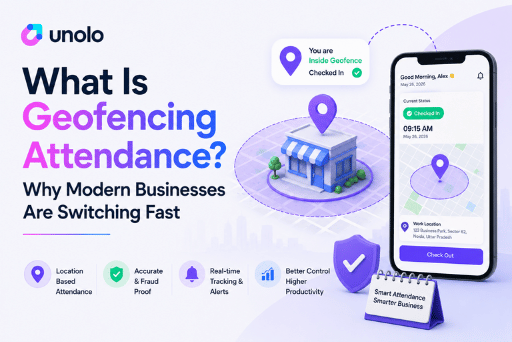
Unolo’s location-based attendance system requires employees to mark attendance from within a defined geographical zone. If your sales executive is supposed to be at a client site in Andheri, they cannot mark attendance from their flat in Borivali. The geofencing feature enforces this automatically, without requiring a manager to manually cross-check every single entry.
For companies where employees visit multiple sites throughout the day, Unolo’s geo-verified client visit feature adds another layer of accountability. Attendance and task completion are verified through GPS coordinates and, in many cases, selfie-based check-ins with facial recognition. This is not just about catching dishonesty. It also protects your honest employees by giving them a clear record of everywhere they went and everything they did.
The real-time location tracking dashboard means a manager in Delhi can see exactly where their field team across Rajasthan is at any given moment. Anomalies become visible immediately rather than turning up as discrepancies at the end of the month when they are harder to address.
Unolo also handles a common adjacent problem in Indian field operations: fake conveyance claims. The platform automatically calculates the distance actually travelled and compares it against what is being claimed, flagging differences for review. Proxy attendance and inflated travel claims often go hand in hand, so solving one while ignoring the other leaves you only half protected.
For companies running shift-based operations, Unolo supports customised shift configurations and roster-based attendance marking. This makes it easy to set different rules for different teams, locations, or job types, all within one platform.
Create Accountability Without Creating a Culture of Suspicion
The goal is not to treat every employee as a potential fraudster. It is to build systems where the honest majority is protected, the dishonest minority cannot game the system, and managers have real data to work with.
When you roll out a location-verified attendance system, communicate the reason behind it openly. Tell your team that this is about fair compensation, accurate records, and protecting the company’s resources, including the salary pool that everyone draws from. Frame it as a fairness measure, not a surveillance measure.
When employees understand that the system protects them as much as it protects the company, the resistance tends to be lower.
Conclusion
Policies mean nothing if they are not enforced consistently. If proxy attendance is discovered and the response is an informal chat that leads to no action, you have signalled that the behaviour is acceptable as long as you do not get caught too obviously.
Build a clear escalation path: a documented warning for a first offence, a more serious consequence for a second, and a termination policy for repeat violations. Make sure managers are trained to handle these conversations properly and that HR is involved from the first documented instance.
The combination of a clear policy, a consistent enforcement process, and a technology layer that removes the opportunity for proxy attendance is what actually changes behaviour over time.
Indian businesses, especially those with large field forces, have a real opportunity to clean up their attendance data, reduce payroll leakage, and build fairer workplaces. The tools exist. The question is whether you are willing to use them.
If you want to see how Unolo can work for your specific field operations, a 14-day free trial is available at unolo.com.